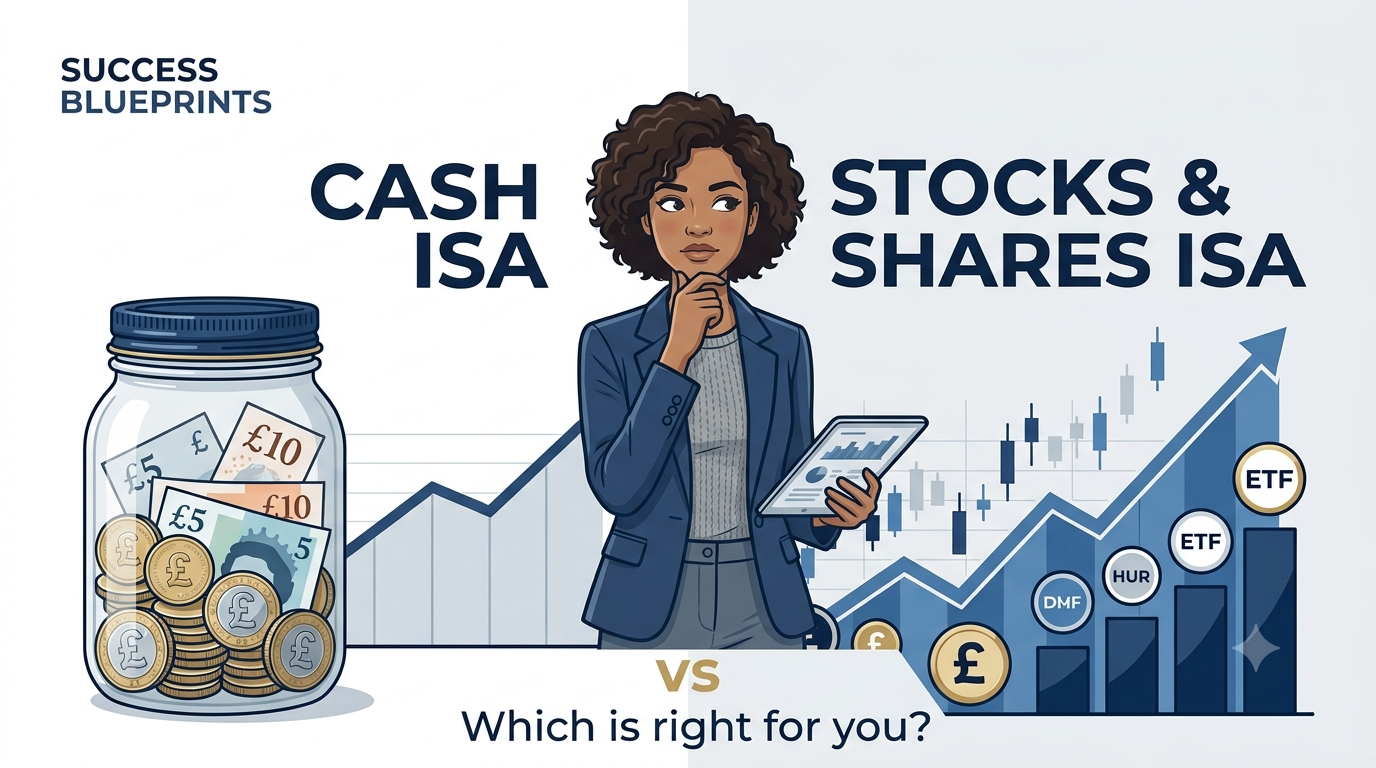
Cash ISA vs Stocks and Shares ISA: Which Is Better in 2026/27?
A Cash ISA and a Stocks and Shares ISA can both shelter your returns from UK tax. But they do different jobs. One is a savings account; the other is an investment account whose value can rise and fall.
The short answer is simple: a Cash ISA is usually more suitable for an emergency fund or money you expect to spend within about five years. A Stocks and Shares ISA may be more suitable for longer-term goals if you can accept market falls and leave the money invested.
For the 2026/27 tax year, the overall ISA allowance is £20,000. You can split it across multiple ISA accounts, including cash and investments. For a fuller explanation, see our current UK ISA rules and allowances guide.
QUICK ANSWER Choose according to the goal, not
according to which ISA sounds more sophisticated. Cash provides
stability; investments offer more growth potential but no guaranteed
result. Many people sensibly use both.
Cash ISA vs Stocks and Shares ISA at a glance
| Feature | Cash ISA | Stocks and Shares ISA |
|---|---|---|
| What it holds | Cash deposits | Funds, ETFs, shares, bonds and other eligible investments |
| Main aim | Protect money and earn tax-free interest | Grow money over the long term |
| Value can fall? | Not because markets fall, though inflation can reduce spending power | Yes. Investments can fall and you may get back less than you paid in |
| Typical timeframe | Short-term goals and emergency savings | Usually goals at least five years away |
| Return | A stated variable or fixed interest rate | Uncertain market growth, income or losses |
| Access | Depends on easy-access, notice or fixed-term conditions | You normally sell investments first; timing and price are not guaranteed |
| Costs | Often no explicit account fee; penalties or restrictions may apply | Platform, fund, dealing and transfer charges can apply |
| Tax inside ISA | No UK Income Tax on interest | No UK Income Tax on investment income and no Capital Gains Tax on gains |
| FSCS context | Eligible deposits: up to £120,000 per person, per authorised firm | Eligible investment claims: up to £85,000 per person, per firm; market losses are not covered |
What is a Cash ISA?
A Cash ISA is a tax-free savings account. Your provider pays interest, and you do not pay UK Income Tax on that interest. The account may be easy access, notice-based or fixed for a set period.
Cash ISAs are designed for saving, not investing. Your balance does not move with the stock market, which makes cash useful when protecting the amount you have matters more than pursuing higher long-term growth.
Cash can still lose purchasing power. If the interest rate is lower than inflation, the number in your account may rise while the amount it can buy falls.
When can a Cash ISA make sense?
- You are building an emergency fund.
- You expect to use the money within the next five years, perhaps
for a house deposit, car or planned expense. - You cannot accept a temporary fall in value before the goal
date. - Tax-free interest is useful because your taxable savings interest
may exceed your Personal Savings Allowance.
What is a Stocks and Shares ISA?
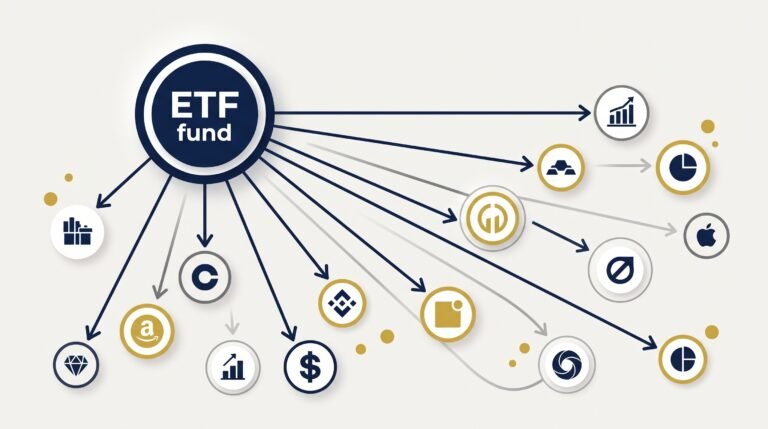
A Stocks and Shares ISA is a tax wrapper for eligible investments. Depending on the provider, it can hold funds, exchange-traded funds (ETFs), individual shares, investment trusts, corporate bonds and government bonds.
The ISA itself does not choose or diversify your investments. You still decide what to hold. If this is new territory, start with our practical six-step plan for building wealth with ISAs and ETFs before comparing platforms.
Investment income and capital gains generated inside the ISA are sheltered from UK Income Tax and Capital Gains Tax. You also do not report normal ISA income or gains on a Self Assessment tax return.
The trade-off is uncertainty. Investments can fall sharply, and there is no guarantee that you will recover your money by the date you need it. A longer timeframe gives you more opportunity to wait through market declines, but it does not remove risk.
When can a Stocks and Shares ISA make sense?
- Your goal is at least five years away and ideally
longer. - You have accessible emergency savings and are not relying on this
money for near-term bills. - You understand that your account may be worth less than you paid
in, particularly over shorter periods. - You want a tax-efficient way to build a diversified long-term
portfolio.
The key differences explained
1. Certainty versus market risk
A Cash ISA offers much greater certainty over the pound value of your savings. A Stocks and Shares ISA exposes your money to market movements. A diversified fund can reduce the impact of any single company failing, but it cannot stop the whole market falling.
This is why your timeframe matters. If your deposit is needed next year, a market decline could derail the purchase. If retirement is 20 years away, you may have more time to ride out declines and continue contributing.
2. Return potential versus inflation risk
Cash pays interest. Investments may produce capital growth and income, but both can vary. Over long periods, diversified investments have greater growth potential than cash, while cash usually provides a smoother journey.
Consider a purely illustrative £10,000 example. At a constant 3% a year, it would grow to about £13,439 after ten years. At an assumed 6% annual investment return, it would grow to about £17,908. The £4,469 difference is not a forecast: cash rates change, investment returns are uneven, fees reduce results and losses are possible.
3. Access to your money
An easy-access Cash ISA may let you withdraw quickly. Notice and fixed-term accounts can restrict access or reduce the interest paid. Always read the withdrawal conditions.
You can normally sell investments in a Stocks and Shares ISA, but access is not instant or price-certain. Trades must settle, withdrawals take processing time and a forced sale during a market fall can lock in a loss.
4. Fees and charges
Cash ISA returns are usually presented as an annual equivalent rate, or AER. You may not see a separate account fee, although early-access penalties, introductory rates and transfer restrictions can affect the outcome.
Stocks and Shares ISAs can involve a platform fee, fund fee, dealing charge, foreign-exchange charge and transfer or exit costs. Small percentage differences compound, so compare the total annual cost rather than one headline fee.
5. What FSCS protection does — and does not — cover
Eligible cash deposits with a UK-authorised bank, building society or credit union are protected by the Financial Services Compensation Scheme up to £120,000 per eligible person, per authorised firm. Different brands can share one banking licence, so check the FSCS protection details rather than assuming every brand has a separate limit.
For eligible investment claims, FSCS protection can be up to £85,000 per person, per firm when an authorised provider or adviser has failed and the claim qualifies. It does not compensate you simply because your investments performed badly or markets fell.
The ISA rules to know in 2026/27
The official 2026/27 ISA rules allow an adult to pay up to £20,000 across ISA accounts during the tax year, which runs from 6 April to 5 April. The allowance measures new contributions, not the total value already held inside your ISAs.
- You can put all £20,000 into one eligible ISA or split it across
multiple accounts. - You can subscribe to more than one Cash ISA and more than one
Stocks and Shares ISA, provided total new payments stay within the
overall limit. - Unused allowance does not carry forward after 5 April.
- A flexible ISA may let you withdraw and replace money in the same
tax year without using extra allowance. Not every ISA is
flexible. - To preserve the tax wrapper when moving existing ISA money, use
the new provider’s formal ISA transfer process instead of withdrawing it
yourself.
Important Cash ISA changes from 6 April 2027
The government has announced ISA reforms due from 6 April 2027. They do not reduce the overall £20,000 ISA allowance, but they will change how cash can be used.
- For people under 65, the annual Cash ISA contribution limit will
be £12,000 within the £20,000 overall allowance. - For people aged 65 or over, the Cash ISA limit will remain
£20,000. - Transfers from non-cash ISAs into Cash ISAs will no longer be
permitted for those under 65; transfers from Cash ISAs to non-cash ISAs
will still be allowed. - A 22% charge will apply to interest paid on cash held inside
non-cash ISAs, and a non-cash ISA will not be allowed to consist
entirely of cash-like money market funds.
The government says regulations will be laid before the start date. Check the final rules and your provider’s terms before making a transfer or contribution around April 2027.
Which ISA should a beginner choose?
Start with the purpose and date for the money. Risk tolerance matters, but it should not be used to ignore a short deadline or the need for emergency access.
Choose a Cash ISA when…
- the goal is less than five years away;
- the balance must not fall before a fixed date;
- the money is part of your emergency fund; or
- you are not yet comfortable with investment risk.
Consider a Stocks and Shares ISA when…
- the goal is at least five years away and preferably
longer; - you can afford to leave the money invested through market
falls; - you have a suitable cash buffer already; and
- you understand the investment, diversification and total
fees.
Use both when your goals have different dates
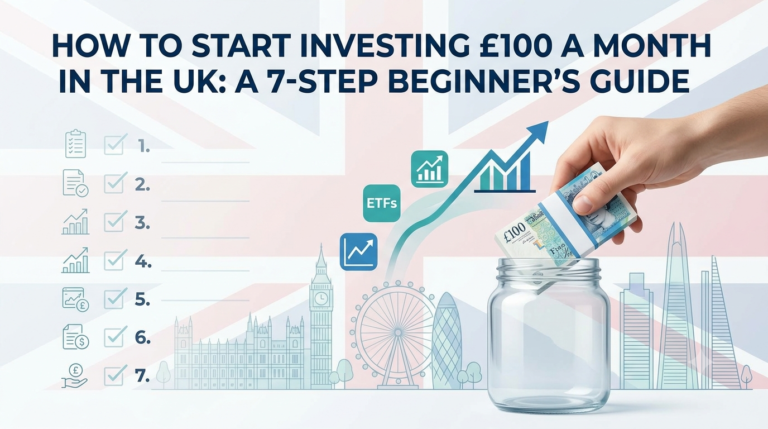
The decision is not all-or-nothing. You might keep a £6,000 emergency fund and a near-term house deposit in cash, while investing £100 a month for retirement in a Stocks and Shares ISA. In 2026/27, both sets of new payments share the same £20,000 overall allowance.
Four simple examples
- Emergency fund: Priya wants six months of
essential expenses available without market risk. An easy-access Cash
ISA could fit, provided the rate and withdrawal terms are
competitive. - First-home deposit in three years: Daniel needs
a known amount on a known date. Cash is usually more appropriate than
risking a market fall shortly before completion. - Retirement in 20 years: Aisha has an emergency
fund and can accept short-term falls. A diversified Stocks and Shares
ISA may offer more suitable long-term growth potential. - Two goals at once: Marcus keeps holiday money in
cash and invests separately for financial independence. He uses both
wrappers rather than forcing one account to do two jobs.
How to compare ISA providers
Do not choose an ISA from the headline rate, app design or advertising alone. Compare the details that affect your goal and the protection available.
| Account | What to compare |
|---|---|
| Cash ISA | AER; fixed or variable rate; withdrawal terms; flexibility; transfer-in rules; FSCS licence |
| Stocks and Shares ISA | Platform and fund fees; investment range; regular investing; transfer charges; FCA authorisation; customer support |
Provider protection is not the same as investment safety. An authorised platform can fail and FSCS rules may help with an eligible claim; a well-run platform cannot prevent the market value of an ETF or fund from falling.
Common mistakes to avoid
- Investing an emergency fund and then needing to sell during a
market fall. - Assuming a Stocks and Shares ISA is automatically diversified. It
is only a wrapper around the investments you select. - Chasing the highest Cash ISA rate without checking access
restrictions, the end of an introductory rate or a shared banking
licence. - Withdrawing an ISA to switch providers instead of using the
formal transfer process. - Ignoring total investment fees because each individual charge
looks small. - Using last year’s market return or today’s cash rate as if it
were guaranteed for the future.
Cash ISA vs Stocks and Shares ISA: the bottom line
Neither ISA is universally better. A Cash ISA is generally the stronger fit for short-term goals, emergency savings and anyone who needs certainty. A Stocks and Shares ISA can be more suitable for long-term wealth building when you can tolerate falls and avoid withdrawing at the wrong time.
Your plan may use both: cash for resilience and investments for long-term growth. For the wider strategy, read our six-step plan for building wealth with ISAs and ETFs.
Want a simple checklist for choosing an ISA and building your first ETF watchlist? Get the free UK ETF & ISA Starter Kit from Success Blueprints.
Frequently asked questions
Can I have a Cash ISA and a Stocks and Shares ISA at the same time?
Yes. In 2026/27, you can pay into multiple ISA accounts, including both types, as long as your total new contributions do not exceed £20,000. A Lifetime ISA has its own £4,000 contribution limit, which also counts towards the overall allowance.
Can I transfer a Cash ISA to a Stocks and Shares ISA?
Yes. Use the receiving provider’s ISA transfer process so the money keeps its tax-free status. Do not withdraw it and then pay it back in unless you understand the allowance consequences. From 6 April 2027, Cash-to-non-cash transfers will remain possible, but under-65s will not be able to transfer non-cash ISAs into Cash ISAs.
Is a Cash ISA completely risk-free?
It avoids stock-market risk, but not every risk. Inflation can reduce the spending power of cash, fixed accounts can restrict access, and FSCS protection depends on eligibility and the authorised firm behind the brand.
Is a Stocks and Shares ISA suitable for £100 a month?
It can be, if the goal is long term, the provider accepts that contribution level and the total fees are reasonable. The amount is less important than having an emergency buffer, choosing suitable diversified investments and continuing through normal market ups and downs.
Important: This article is for education only and is not personalised financial advice. ISA and tax rules can change. Investments can fall as well as rise, and you may get back less than you invest. If you are unsure, consider speaking to an FCA-authorised financial adviser.


One Comment
Comments are closed.