How to Build Wealth with ETFs: 7 Proven Tips for UK Investors
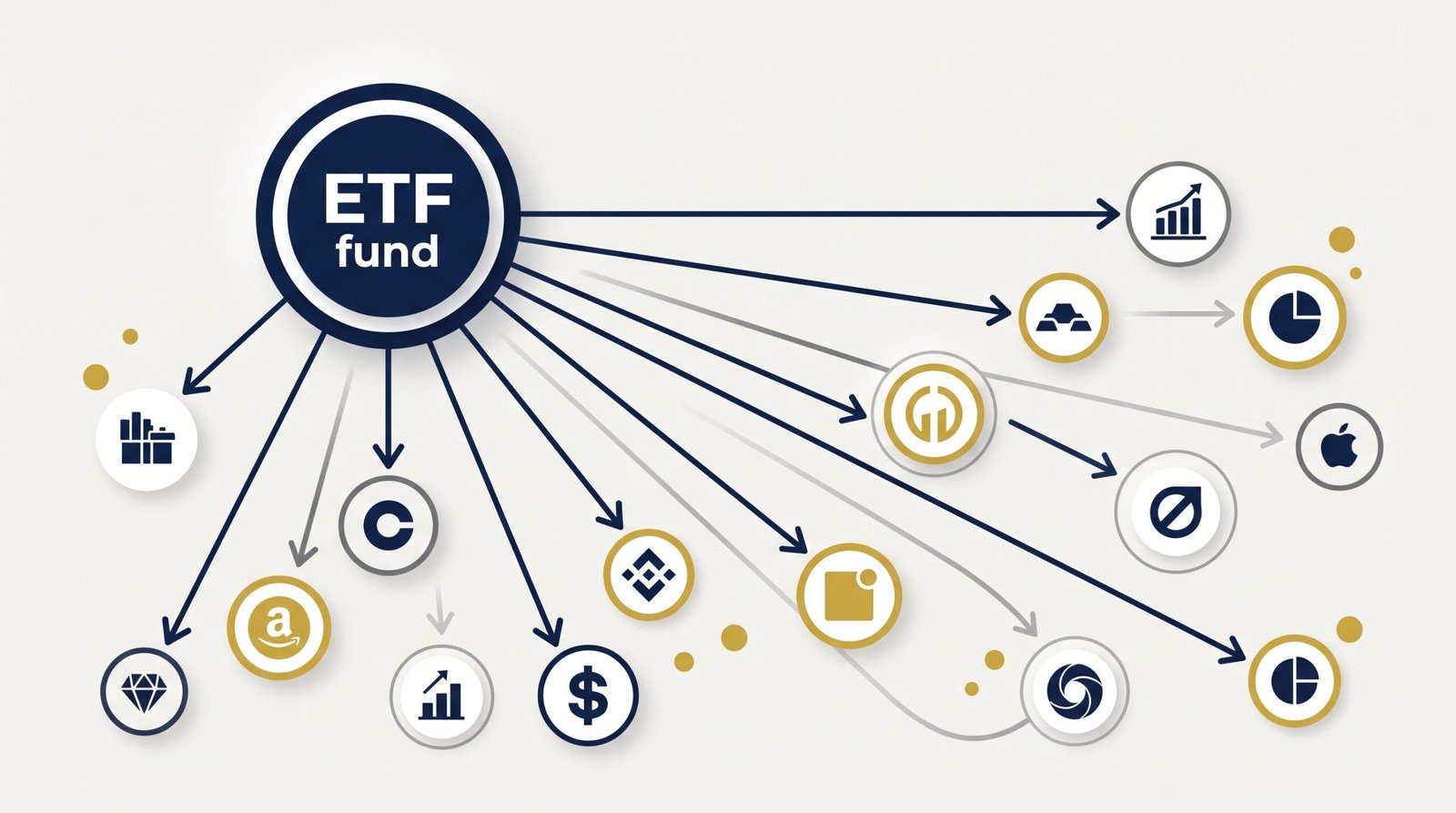
You want to start investing. However, the moment you open a platform you’re hit with UCITS, Acc, Dist, OCF, synthetic replication. The whole experience can feel designed to deter UK Investing. Underneath the jargon, an exchange-traded fund is a simple idea: one purchase spreads money across many investments.
This guide strips out the noise.
Additionally, by the end you’ll know what an ETF actually owns.
It explains what it really costs and where the risks sit.
It also shows how to hold one inside a Stocks and Shares ISA for UK Investing.
It helps you read fund pages clearly.
Important: This article is for educational purposes only and does not constitute personal financial advice. Investments can fall as well as rise, and you may get back less than you invest.
Key takeaways
- An ETF is a single fund holding a basket of investments — shares, bonds, commodities or a mix — that you buy and sell on a stock exchange like a share.
- Most ETFs UK beginners use are passive index trackers, which follow an index such as the FTSE 100 or a global index rather than trying to beat the market.
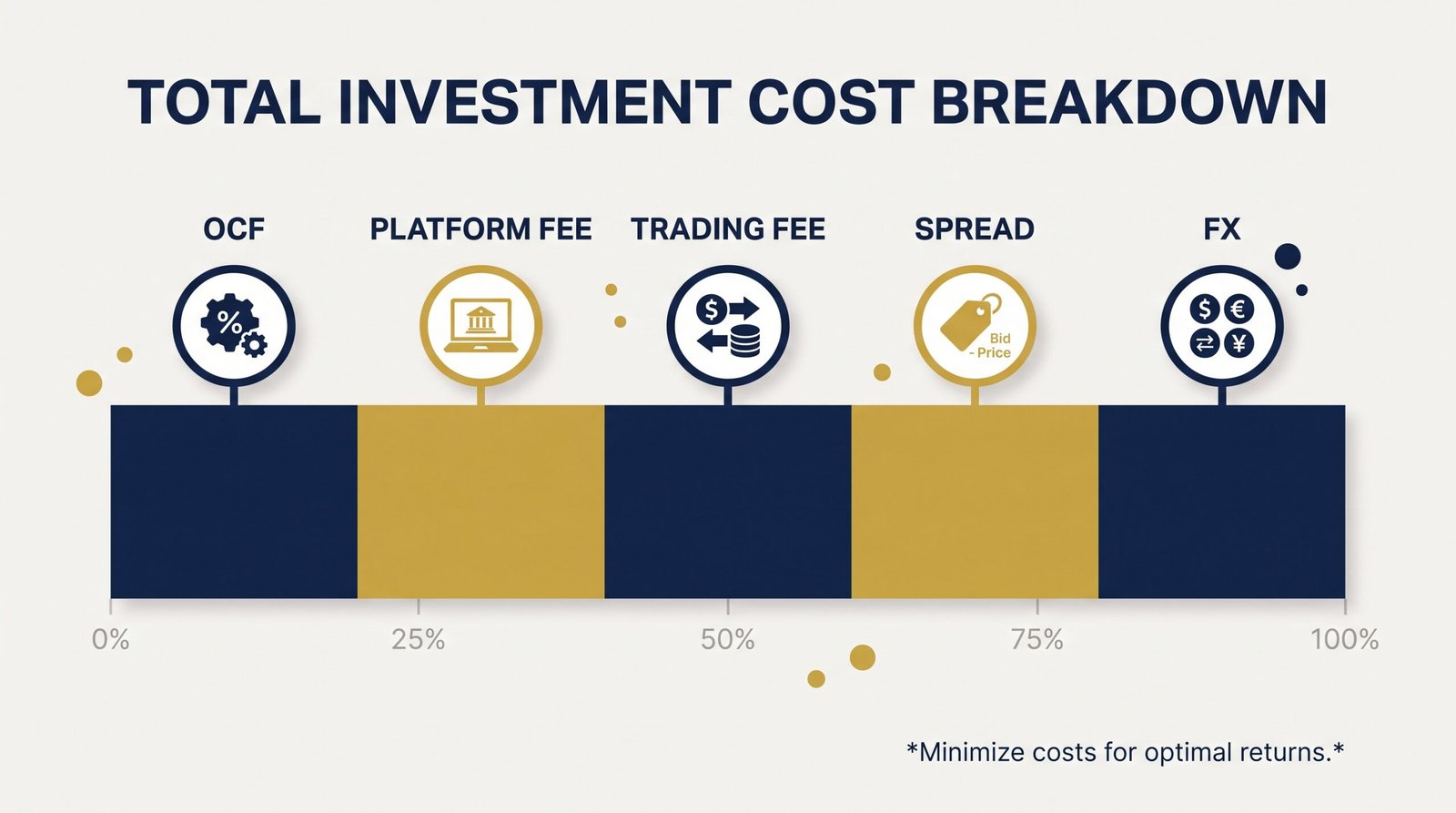
- Costs matter. The fund’s Ongoing Charges Figure (OCF) is only part of the picture — platform fees, trading fees, spreads and currency charges all add up.
- Accumulation vs income is one of the first decisions you’ll make: dividends reinvested automatically, or paid out as cash.
- Many ETFs can be held inside a Stocks and Shares ISA, and the account you use can matter as much as the fund you pick.
What is an ETF?
An ETF, or exchange-traded fund, is an investment fund that holds a collection of assets.
Those assets might include:
- Company shares
- Government bonds
- Corporate bonds
- Commodities
- Property-related investments
- A mixture of different investments
Many ETFs are designed to track a particular stock-market index. An ETF might follow:
- The FTSE 100
- The FTSE All-Share
- The S&P 500
- The MSCI World Index
- The FTSE All-World Index
Rather than buying shares in every company within an index yourself, you buy units in a fund that aims to follow that index for you. That’s why ETFs have become one of the simplest ways for UK investors to build a diversified portfolio.
How does an ETF work?
Picture trying to invest in hundreds of large companies around the world on your own. Buying every share individually would be expensive, slow and a nightmare to keep on top of. Who has the time?
An ETF does that work for you. The provider builds a fund containing investments designed to follow a particular index or strategy, and you buy shares or units in that fund through an investment platform.
If the value of the investments inside the fund rises, the value of your holding generally rises too. If those investments fall, your holding can fall.
A simple example
Say an ETF tracks an index of 500 companies. Instead of deciding which individual companies to buy, your money buys exposure to the whole collection.
Your outcome no longer depends on one business getting it right. That single feature — spreading the bet — is a big part of why long-term investors like ETFs.
Why “exchange-traded”?
The clue is in the name. ETFs are bought and sold on stock exchanges in much the same way as company shares, so their price can move throughout the trading day.
On a UK platform you’ll typically see:
- A current market price
- A buy price
- A sell price
- Daily price movements
- Trading volume
That’s different from some traditional funds, which may only calculate a price once a day. For most long-term investors, though, minute-by-minute wobbles matter far less than what the fund holds and how long you stay invested.
What is an index?
An index is simply a way of measuring the performance of a group of investments.
The FTSE 100 tracks 100 large companies listed on the London Stock Exchange. The S&P 500 tracks around 500 large US companies. A global index may span many countries.
When an ETF is built to copy the performance of one of these indexes, that’s called index tracking, or passive investing.
Passive ETFs vs active ETFs
Not every ETF follows an index. There are two broad types, and knowing the difference will save you a lot of confusion.
Passive ETFs
Passive ETFs aim to track an index as closely as possible. They don’t try to predict which companies will do best — they follow a predefined set of rules.
Because that requires less active management, passive ETFs often carry relatively low ongoing charges.
Active ETFs
Active ETFs have managers deciding what to hold, usually aiming to beat a market or hit a particular objective.
That comes with higher costs, and the fund can behave quite differently from the wider market.
If you’re just starting out, this is one of the most useful distinctions to get straight before you choose any fund.
Why do UK investors use ETFs?
1. Diversification
Buying one company ties your money tightly to that one business. An ETF may hold hundreds or thousands.
Diversification doesn’t remove investment risk — nothing does — but it does reduce how much rides on any single company.
2. Relatively low costs
Many index-tracking ETFs charge relatively low annual fees. Over decades, keeping costs under control can make a meaningful difference to what you end up with.
3. Convenience
One purchase can provide broad market exposure, instead of researching and buying dozens of holdings yourself.
4. Transparency
ETF providers normally publish:
- The index the fund tracks
- Its main holdings
- Countries represented
- Sectors represented
- Charges
- Investment strategy
5. Accessibility
Many UK platforms let you start with relatively modest amounts. Some support fractional investing or regular monthly plans, though availability varies by provider.
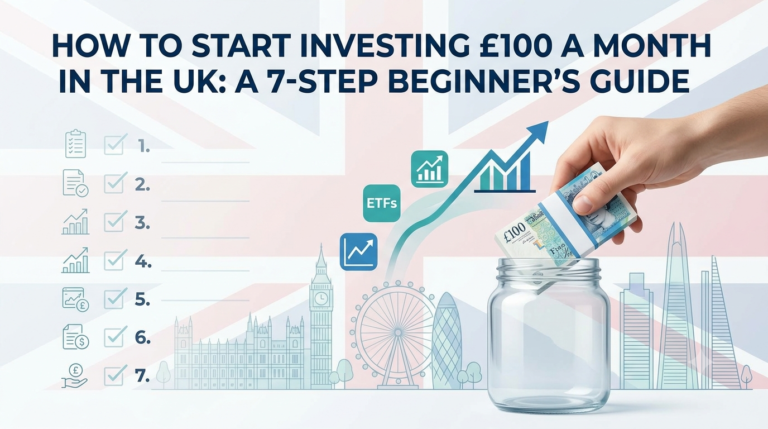
Planning to invest a set amount each month? Our guide to how to start investing £100 a month in the UK walks through the practical setup.
What does an ETF actually own?
It depends entirely on the fund — and this is where beginners most often trip up.
A global equity ETF could own shares across the US, UK, Europe, Japan and emerging markets. A bond ETF could own government or corporate bonds. A technology ETF might concentrate almost entirely on tech companies.
Two funds can both be ETFs and behave nothing alike.
So don’t assume a fund is diversified just because it’s an ETF. A fund holding 2,000 global companies is a very different proposition from one holding 30 companies in a single industry. Always look inside before you buy.
Physical vs synthetic ETFs
You’ll see ETFs described as either physical or synthetic. Here’s the plain-English version.
Physical replication
A physical ETF buys the investments it’s designed to track. An ETF following a stock-market index may own shares in the companies in that index — some hold every company, others hold a representative sample.
Synthetic replication
A synthetic ETF uses financial contracts, usually derivatives, to reproduce an index’s performance. Rather than owning every investment directly, the fund enters into arrangements with financial counterparties.
Synthetic ETFs can be useful for certain markets, but they bring extra considerations — counterparty risk in particular. Check the replication method before you invest.
What does UCITS mean?
You’ll spot UCITS in a lot of ETF names and documents. It refers to a regulatory framework for investment funds, and many ETFs available to UK retail investors are UCITS-compliant.
The designation sets rules covering areas such as diversification, investor protection and fund structure.
What it doesn’t do is stop an ETF losing money. You still need to understand what the fund invests in and the risks involved.
Accumulation vs income ETFs
This is one of the most important distinctions for beginners — and one of the easiest to get wrong when you’re scanning a fund list.
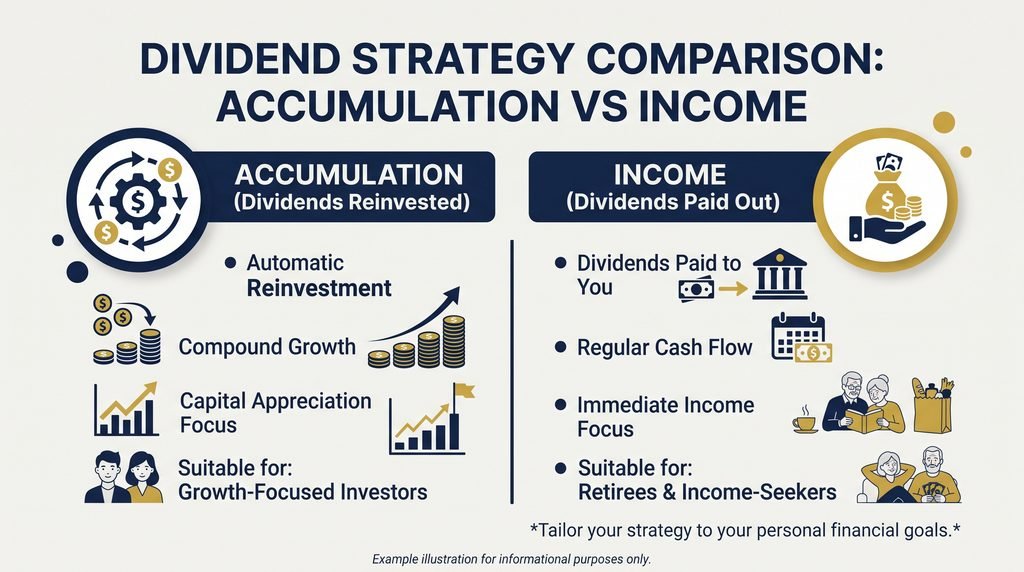
Companies held inside an ETF may pay dividends. The fund has to decide what happens to that income.
Accumulation ETFs
An accumulation ETF automatically reinvests income back into the fund. Look for:
- Acc
- Accumulating
- Capitalising
Because reinvestment happens automatically, this can make long-term compounding far more convenient.
Income ETFs
An income ETF distributes income to investors. Look for:
- Inc
- Dist
- Distributing
The income is normally paid into your investment account, which suits investors who want cash from their portfolio.
Neither is automatically better. Building wealth over decades? Accumulation is often the more convenient route. Want regular investment income? Distributing funds may suit you better.
We go deeper on this in Accumulation vs Income ETFs: Which Is Right for UK Investors?
What fees do ETFs charge?
Costs come straight off your returns, so this section is worth reading twice.
Ongoing Charges Figure (OCF)
You’ll often see something like OCF: 0.20%. That means the fund’s annual running costs are roughly 0.20% of the amount invested — around £20 a year on £10,000.
It’s normally reflected inside the fund rather than arriving as a separate bill.
Platform fees
Your investment platform may charge separately for holding your investments. This is on top of the fund’s own charge.
Trading fees
Some platforms charge every time you buy or sell. Others offer free or discounted regular investing.
Bid-offer spread
ETFs have a buying price and a selling price, and the gap between them is the spread. Heavily traded ETFs tend to have smaller spreads; less liquid funds can have wider ones.
Currency costs
If an investment involves currency conversion, your platform may charge a foreign-exchange fee.
The takeaway: never compare ETFs on the headline annual charge alone. Look at the total cost of investing.
Can you hold ETFs in a Stocks and Shares ISA?
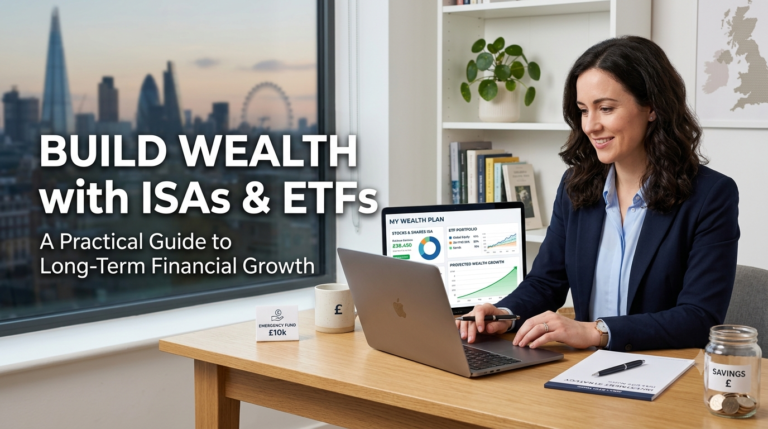
Many ETFs can be held inside a Stocks and Shares ISA, and this is one of the most common ways UK investors use them.
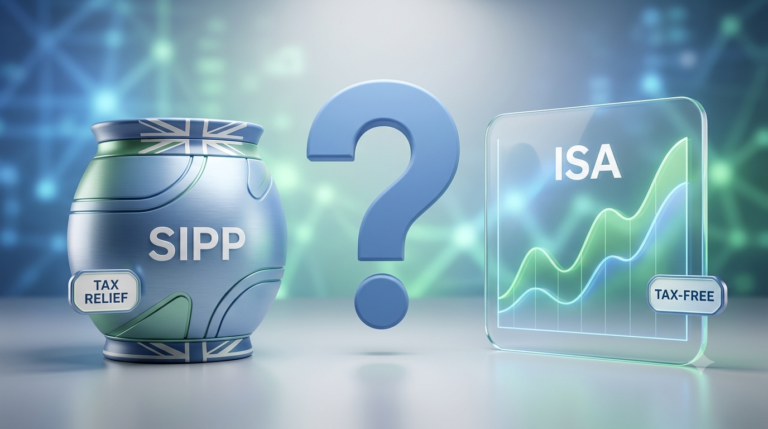
Investments held inside an ISA can receive valuable UK tax advantages. So rather than obsessing over which ETF to buy, it’s worth giving equal thought to which account you hold it in.
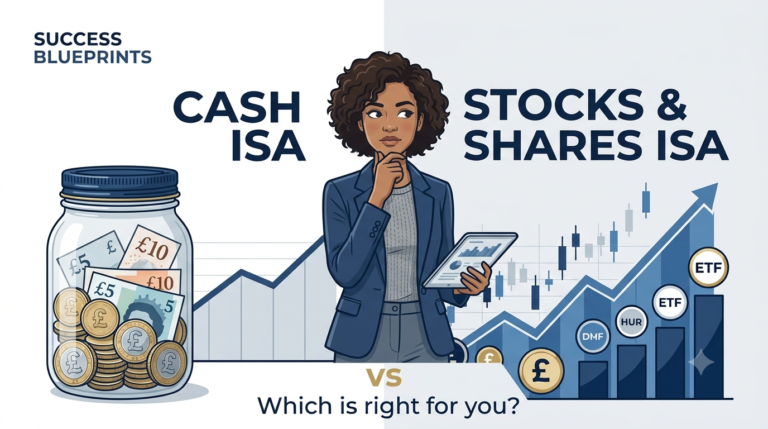
New to ISAs? Start with Stocks and Shares ISA for Beginners, then check the current UK ISA rules and allowances for 2026/27.
Tax rules and allowances can change, so always check the current rules before making financial decisions.
ETFs inside an ISA vs outside an ISA
You can invest in ETFs outside an ISA using a general investment account. But investments held outside a tax-efficient wrapper can create tax considerations involving dividends and capital gains.
Inside a Stocks and Shares ISA, qualifying investments receive ISA tax advantages. That’s why many UK investors consider using their available ISA allowance before investing through a taxable account.
The right approach depends on your circumstances.
How do you make money from an ETF?
There are generally two sources of return.
Capital growth. If the underlying investments rise in value, the ETF price may increase. Buy £1,000 of units that later become worth £1,200 and you have an unrealised gain of £200. It isn’t guaranteed — the value could also fall.
Income. The investments inside the fund may produce dividends or interest. Depending on the fund type, that income is either reinvested automatically or distributed to you.
Over the long run, returns typically come from a combination of the two.
What are the risks of ETFs?
ETFs are not risk-free, and understanding the downside matters just as much as understanding the appeal.
- Market risk. If the market your ETF tracks falls, your investment falls. Even a global ETF can decline significantly during major downturns.
- Concentration risk. Some ETFs focus heavily on one country, one industry, one theme, or a small number of companies. These can be far more volatile than broad-market funds.
- Currency risk. If a fund owns international investments, currency movements can affect returns for UK investors.
- Tracking difference. An ETF may not exactly reproduce its index. Fees, trading costs and fund management can create a gap.
- Liquidity risk. Some ETFs trade far more often than others. Lower trading activity can mean wider spreads and less efficient trading.
- Counterparty risk. Relevant for synthetic ETFs that rely on financial contracts with other institutions.
Global ETF vs S&P 500 ETF
This one comes up constantly, and it’s a fair question.
An S&P 500 ETF primarily gives you exposure to large US companies. A broad global ETF may include:
- US companies
- UK companies
- European companies
- Japanese companies
- Companies from other developed markets
- Potentially emerging markets
Here’s the nuance: the US market represents a major portion of many global indexes, so a global ETF can still carry substantial US exposure. It simply spreads across more geographies as well.
Neither is automatically the better choice. The real question is whether you understand the exposure you’re buying.
ETF vs individual shares
Buying individual shares means choosing specific companies yourself — Apple, Microsoft, Tesco, HSBC, and so on. Buying a broad ETF means buying exposure to many investments through one fund.
Individual shares can potentially produce strong returns, but they concentrate company-specific risk. ETFs make diversification considerably easier.
ETF vs traditional index fund
Both can track investment indexes. The biggest practical difference is usually how they’re bought and sold.
ETFs trade on stock exchanges throughout the day. Traditional index funds are normally bought through a fund platform and priced at specific valuation points.
For long-term investors, both structures can potentially provide low-cost diversified exposure. Rather than assuming one wins, compare:
- Fees
- Platform availability
- Investment minimums
- Regular investing options
- Fund structure
- The index being tracked
How many ETFs does a beginner need?
Fewer than you might think.
More funds do not automatically mean better diversification. One broad global ETF may already contain thousands of companies, and stacking funds that track similar markets creates overlap rather than protection.
Own all three of these, for example:
- A global ETF
- An S&P 500 ETF
- A US technology ETF
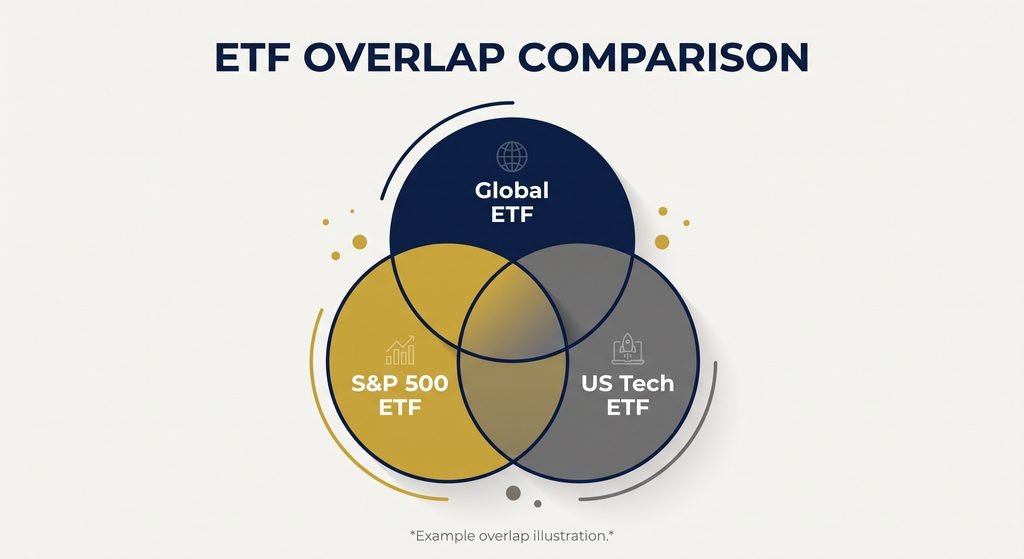
…and you could end up heavily weighted towards the same handful of large American companies without realising it.
So before adding another fund, ask one question: what does this add that I don’t already own?
A portfolio you can explain in a sentence usually beats one you can’t.
7 things to check before choosing an ETF
- What index does it track? Make sure you understand what that index represents.
- What does the ETF actually own? Check the countries, sectors and largest holdings.
- What is the ongoing charge? Compare the OCF with similar funds.
- Is it accumulation or income? Decide whether you want dividends reinvested or paid out.
- How does it replicate the index? Physical or synthetic.
- How large and established is the fund? Review fund size, trading activity and the provider.
- Does it fit your overall plan? Never choose a fund purely because it has performed well recently.
That last point deserves a moment. Your investment should fit your time horizon, risk tolerance, financial goals and existing investments — not last year’s leader board.
A simple ETF example
Suppose you invest £100 a month into a broad-market ETF.
You’re not trying to predict next week’s best-performing company. You’re gradually building ownership across a large number of businesses.
Some months the market rises. Some months it falls. Over longer periods, your outcome will depend on things like:
- Market performance
- Investment fees
- How long you stay invested
- Whether you keep contributing
- How you behave during downturns
Notice how many of those are within your control. That’s why building a consistent process often matters more than picking the perfect fund.
Common ETF mistakes beginners make
Choosing an ETF based on recent performance. A strong year is not a promise. Past performance does not guarantee future returns.
Buying too many overlapping ETFs. More funds can add complication without adding meaningful diversification.
Ignoring fees. Small percentage differences compound into significant sums over long periods.
Investing money you’ll need soon. Stock-market investments can fall sharply over short periods. Money needed for near-term expenses generally shouldn’t depend on short-term market performance.
Panicking when markets fall. Declines are a normal part of investing. Selling simply because prices dropped can turn a temporary fall into a permanent loss.
Investing before building basic financial stability. Before you start, consider whether you have:
- An emergency fund
- Expensive debt under control
- A realistic monthly budget
- Appropriate insurance where needed
Investing works best as part of a wider financial plan, not instead of one.
Frequently asked questions about ETFs
Are ETFs good for beginners?
They can be, because broad-market funds provide diversification through a single investment. But not every ETF is simple or low-risk — some use leverage, derivatives or highly concentrated strategies. Understand the fund before investing.
Can I lose all my money in an ETF?
ETFs can fall significantly in value. A diversified ETF holding hundreds or thousands of established companies is a very different proposition from a speculative fund concentrated in a narrow market. Risk depends largely on what the fund owns.
Do ETFs pay dividends?
Many equity ETFs receive dividends from the companies they hold. An accumulation ETF normally reinvests them; an income ETF normally distributes them.
Can I invest £100 a month into ETFs?
Many UK investment platforms allow regular monthly investing, though minimum amounts and fees vary between providers.
Can I hold ETFs in an ISA?
Many eligible ETFs can be held inside a Stocks and Shares ISA. Your platform should indicate whether a particular investment is available within its ISA.
Is an ETF the same as an index fund?
Not exactly. An ETF is a fund structure. Many ETFs track indexes, but some are actively managed — and traditional investment funds can track indexes too.
The bottom line
You don’t need to become a professional investor to understand ETFs. At their simplest, they let you buy a collection of investments through a single fund.
For UK beginners, the concepts that actually matter are:
- What index the ETF follows
- What investments it contains
- Whether it’s accumulation or income
- How much it costs, in total
- How diversified it really is
- Whether it uses physical or synthetic replication
- How it fits your wider investment strategy
A good investment plan doesn’t need to be complicated. Understanding what you own, keeping costs down, diversifying sensibly and investing consistently will usually matter far more than chasing the next fashionable fund.
Ready to take the next step?
If you’re starting from scratch, download the free UK ETF & ISA Starter Kit. It’s built to help beginners understand Stocks and Shares ISAs, compare ETFs side by side, and organise the decisions involved in making a first investment — without the jargon.
Get the Free UK ETF & ISA Starter Kit →
Or keep reading: