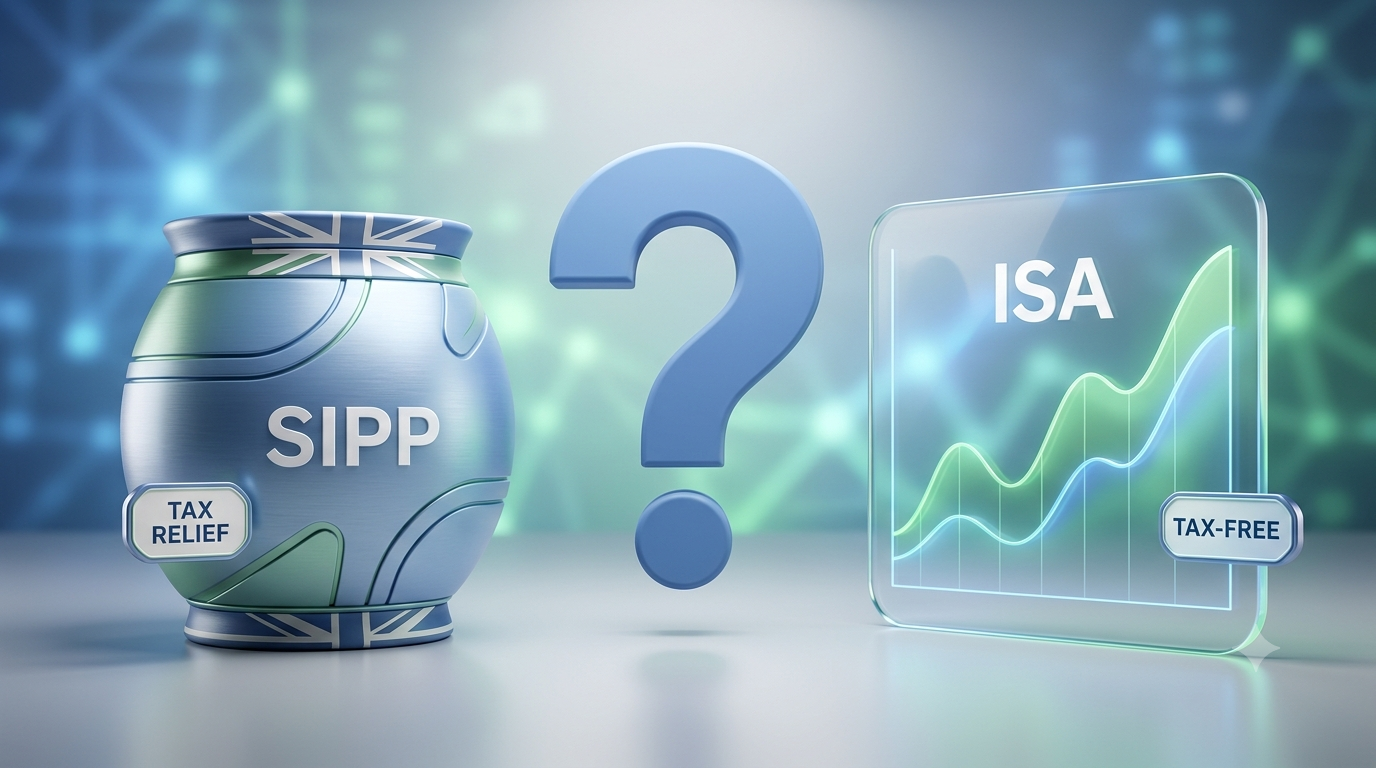
SIPP vs ISA: Which Investment is Right for You?
Choosing between a SIPP and an ISA can feel like choosing between two
versions of the same thing. Both can hold funds, ETFs, shares and other
investments. Both can protect investment growth from UK tax. Both can
help you build wealth over decades.
But they are designed for different jobs.
A Self-Invested Personal Pension, or SIPP, rewards
you for locking money away for retirement. A Stocks and Shares ISA gives
you fewer upfront tax benefits but far more freedom over when and how
you use your money.
So, which is better?
For money you are certain you will not need until retirement, a SIPP
will often have the tax advantage. For financial independence, early
retirement or any goal before pension age, a Stocks and Shares ISA is
usually more flexible. For many UK investors, the best answer is not
SIPP or ISA—it is a carefully chosen combination of both.
This guide explains the differences using the 2026/27 UK rules, with
simple examples and a practical decision framework.
Important: This article is general information, not
personal financial advice. Tax rules can change, and their effect
depends on your circumstances. Investments can fall as well as rise, and
you may get back less than you invest.
What is a SIPP?
A SIPP is a type of personal pension that gives you control over how
your retirement savings are invested. Depending on the provider, you may
be able to choose from funds, ETFs, investment trusts, individual shares
and other permitted investments.
The main attraction is pension tax relief.
With a typical relief-at-source SIPP, a basic-rate taxpayer
contributes £80 and the provider claims £20 from HMRC. That leaves £100
invested in the pension. Higher- and additional-rate taxpayers may be
able to claim further relief, subject to their circumstances and the tax
rules that apply to them.
According to GOV.UK’s
pension tax-relief guidance, personal pension contributions can
normally receive tax relief up to 100% of your relevant annual UK
earnings. Separate annual-allowance rules also apply.
The trade-off is access. SIPP money is normally locked away until the
minimum pension age. This is currently 55 for most people and is
scheduled to rise to 57 from 6 April 2028, although
some people may have a protected pension age.
What is a Stocks and Shares
ISA?
A Stocks and Shares ISA is a tax-efficient investment account. You
contribute from income that has already been taxed, so there is no
pension-style tax relief when the money goes in.
However:
- Investment growth is free from UK Capital Gains Tax.
- Dividends and interest within the ISA are free from UK Income
Tax. - You can normally withdraw money whenever you choose.
- ISA withdrawals are not subject to UK Income Tax.
The 2026/27
ISA allowance is £20,000. This is the maximum you can contribute
across your adult ISAs during the tax year. The limit is shared between
Cash ISAs, Stocks and Shares ISAs, Innovative Finance ISAs and Lifetime
ISAs.
If you are new to investing, read our Stocks
and Shares ISA for beginners guide before choosing investments.
SIPP vs ISA: the
differences at a glance
| Feature | SIPP | Stocks and Shares ISA |
|---|---|---|
| Upfront tax benefit | Pension tax relief is normally available | No tax relief on contributions |
| 2026/27 headline allowance | £60,000 annual pension allowance for most people, including employer contributions |
£20,000 across adult ISAs |
| Earnings restriction | Personal tax-relieved contributions are normally limited by relevant UK earnings |
No earnings requirement |
| Access | Normally from age 55, rising to 57 from 6 April 2028 | Withdrawals normally available at any time |
| Tax on investment growth | No UK Income Tax or Capital Gains Tax while held in the pension | No UK Income Tax or Capital Gains Tax within the ISA |
| Tax when withdrawing | Usually up to 25% tax-free within applicable limits; the remainder is generally taxable income |
Withdrawals are normally tax-free |
| Employer contributions | Possible through pensions, although an employer may not pay into your chosen SIPP |
Not available |
| Best suited to | Retirement income | Flexible long-term goals and pre-pension access |
The allowances are not directly comparable. The SIPP figure sits
within rules covering all your private pensions, including workplace
pension contributions. The ISA allowance covers new money paid into your
ISAs.
Why a SIPP can be
better for retirement
1. Tax
relief gives your investment an immediate boost
Suppose you are a basic-rate taxpayer and pay £100 from your bank
account into a relief-at-source SIPP. Your provider would normally claim
£25 in basic-rate tax relief, leaving £125
invested.
Put the same £100 into a Stocks and Shares ISA and £100 is
invested.
That does not automatically mean the SIPP produces 25% more spendable
income. Pension withdrawals may be taxable, while ISA withdrawals are
normally tax-free. Your future tax rate matters.
Even so, receiving tax relief earlier gives more money the chance to
compound.
2.
Higher-rate tax relief can make the SIPP more attractive
If you pay Income Tax above the basic rate, you may be able to claim
additional pension tax relief. The method depends on how the
contribution is made and how your scheme operates.
This can make pension saving particularly valuable during
higher-earning years. However, do not assume all relief is added
automatically. Check your pension statement and HMRC records, and claim
any extra relief for which you are eligible.
3. Restricted
access can protect retirement savings
Being unable to withdraw SIPP money early may feel like a
disadvantage. For retirement planning, it can also be useful.
The money cannot normally be diverted to a new car, home renovation
or an impulsive purchase. It remains invested for its intended
purpose.
This makes a SIPP useful for disciplined, long-term retirement
saving—but unsuitable for an emergency fund or money you may need before
pension age.
Why an ISA can be
better for flexibility
1. You can access
the money before pension age
An ISA can help fund goals that do not fit pension rules,
including:
- retiring or reducing your working hours before age 57;
- building a deposit for a future property;
- starting a business;
- funding education or family costs; or
- creating a financial-independence bridge before pension access.
That freedom is the ISA’s biggest advantage.
2. Withdrawals are normally
tax-free
Money taken from an ISA does not normally increase your taxable
income. This makes retirement planning simpler and can help you manage
how much taxable pension income you draw.
For example, a retiree might combine taxable SIPP withdrawals with
tax-free ISA withdrawals rather than relying entirely on pension
income.
3. There is no
relevant-earnings requirement
You do not need employment income to contribute to an ISA. This can
be useful if you are taking a career break, living from investment
income or have sold an asset and want to move money gradually into a
tax-efficient account.
You must still meet the ISA eligibility rules and remain within your
annual allowance.
The tax trade-off: a simple
example
Imagine two basic-rate taxpayers each have £100 per month available
and invest for 25 years. For illustration, both investments grow by an
average of 6% a year after charges.
- ISA investor: £100 a month is invested and could
grow to approximately £69,300. - SIPP investor: £100 paid from the bank becomes £125
after basic-rate relief and could grow to approximately
£86,600.
The SIPP is ahead before withdrawals because more money was
invested.
But this is not a complete like-for-like outcome. The ISA balance can
normally be withdrawn tax-free. With the SIPP, up to 25% can usually be
taken tax-free, subject to the lump sum allowance, while the rest is
generally taxable as income.
If 25% of the example SIPP were tax-free and the remaining 75% were
eventually taxed at 20%, its simplified after-tax value would be about
£73,600. That is still ahead of the ISA in this
illustration, but by much less than the headline account balances
suggest.
Actual returns will not be smooth or guaranteed. Charges, tax rates,
contribution timing and withdrawal choices will change the outcome. The
example also excludes any extra relief available to higher-rate
taxpayers and any employer contribution.
Check your
workplace pension before opening a SIPP
If you are employed, your workplace pension should usually come
before additional SIPP contributions.
Your employer may contribute only the legal minimum or may match
extra contributions up to a higher level. Employer money is a benefit
you cannot receive through an ISA, and you may lose it if you contribute
less than the amount needed to obtain the full match.
The legal automatic-enrolment minimum is generally 8% of qualifying
earnings, with at least 3% coming from the employer, although schemes
can use different qualifying structures and many employers pay more.
Check your scheme rather than relying on the headline percentages.
A sensible order for many employees is:
- Join the workplace pension.
- Contribute enough to receive the maximum employer contribution
available. - Build an emergency fund and deal with expensive debt.
- Use an ISA, SIPP or both for additional long-term investing.
A SIPP can sit alongside a workplace pension. It does not replace the
need to understand the fees, investment choices and benefits already
available through your employer’s scheme.
Important 2026/27 limits and
rules
ISA allowance
The overall adult ISA subscription limit for 2026/27 is
£20,000.
Most ISA withdrawals do not restore your allowance. A flexible ISA
may let you replace withdrawn money in the same tax year without using
more allowance, but only when the provider’s rules permit it. Check
before withdrawing.
Pension annual allowance
The standard pension annual allowance for 2026/27 is
£60,000. It covers contributions across your private
pensions, including amounts paid by you and your employer.
Defined-benefit pension growth can also count.
Your allowance may be lower if you have a high income or have
flexibly accessed taxable money from a defined-contribution pension. The
Money Purchase Annual Allowance for 2026/27 is
£10,000.
Unused annual allowance may sometimes be carried forward from the
previous three tax years, subject to the rules. See the official GOV.UK
annual-allowance guidance before making a large contribution.
Tax-relief limit
The £60,000 annual allowance does not mean everyone can personally
contribute £60,000 and receive tax relief.
Tax relief on your own contributions is normally limited to 100% of
your relevant UK earnings for the tax year. Someone with low or no
relevant earnings can usually contribute up to £2,880 net to a
relief-at-source pension, which becomes £3,600 after basic-rate tax
relief, provided the eligibility rules are met.
Pension withdrawals
You can normally take up to 25% of your pension tax-free, subject to
the applicable lump sum allowance. The standard lump sum allowance is
currently £268,275 for most people, although individual
protection and previous pension withdrawals can affect it.
The remaining pension withdrawals are generally taxed as income.
Large withdrawals can push you into a higher tax band, so the timing
matters.
When should you choose a
SIPP?
A SIPP may be the stronger choice when:
- the money is definitely for retirement;
- you already receive the full workplace-pension employer
contribution; - pension tax relief is valuable at your current tax rate;
- you are comfortable leaving the money inaccessible until pension
age; - you want investment choices not available in your workplace scheme;
and - the SIPP’s total fees are competitive.
A SIPP is not automatically better just because it offers more
investments. A large investment menu can encourage unnecessary trading,
and platform, fund and dealing fees can reduce long-term returns.
When should you
choose a Stocks and Shares ISA?
An ISA may be the stronger choice when:
- you may need the money before pension age;
- you want to retire early and need a bridge to age 57;
- you value simple, tax-free withdrawals;
- you have already used the pension contribution level that suits your
plan; - you have no relevant earnings for a larger tax-relieved pension
contribution; or - you want flexibility while your long-term goals are still
developing.
An ISA’s easy access does not make it suitable for short-term
investing. If you might need the money within the next five years,
investing may expose you to losses at the wrong time. Cash may be more
appropriate for shorter goals.
For many investors, the
answer is both
Using both accounts can give you three valuable features:
- tax relief on money reserved for retirement;
- flexible access to money held in the ISA; and
- a mixture of taxable and tax-free withdrawals later.
One simple approach is to divide new long-term contributions by
purpose rather than chasing a perfect percentage.
For example:
- money for retirement after age 57 goes into a workplace pension or
SIPP; - money for early retirement or flexible goals goes into a Stocks and
Shares ISA; and - money needed within roughly five years remains in suitable cash
savings.
The investments inside the SIPP and ISA can be similar. The crucial
difference is the tax wrapper and its access rules, not necessarily the
fund or ETF you buy.
Read our practical
guide to building wealth with ISAs and ETFs for a wider step-by-step
plan.
A practical SIPP vs
ISA decision checklist
Before contributing, ask:
- Have I secured the full employer pension contribution available to
me? - Do I have an emergency fund?
- Have I dealt with expensive debt?
- Could I need this money before age 57?
- What tax relief will I actually receive?
- What tax might I pay when withdrawing from the pension?
- Are the platform and investment fees competitive?
- Is the investment diversified and suitable for my risk
tolerance? - Would splitting the contribution between a SIPP and an ISA better
match my goals?
If you cannot confidently answer the access question, avoid locking
all your spare money into a pension.
SIPP vs ISA: the final
verdict
For pure retirement saving, a SIPP often wins on tax
efficiency, particularly when pension tax relief is received at
a higher rate than the tax eventually paid on withdrawals.
For flexibility, early retirement and access before pension age, a
Stocks and Shares ISA wins.
The strongest long-term plan for many UK investors is:
- maximise valuable employer pension contributions;
- use a pension or SIPP for money definitely intended for later
retirement; - use a Stocks and Shares ISA for flexible long-term wealth; and
- keep short-term and emergency money out of both investment
accounts.
The wrapper matters, but your saving rate, investment costs,
diversification and consistency will usually matter more than constantly
switching between accounts.
Frequently asked questions
Is a SIPP better
than an ISA for retirement?
Often, but not always. A SIPP offers pension tax relief, which can
increase the amount invested. However, withdrawals are restricted until
pension age and are partly taxable. An ISA receives no upfront tax
relief but offers flexible, normally tax-free withdrawals.
Can I
invest in both a SIPP and a Stocks and Shares ISA?
Yes. They have separate allowance systems, so you can contribute to
both if you meet the rules. Many investors use a SIPP for retirement and
an ISA for goals that may arise before pension age.
Should I
use a SIPP instead of my workplace pension?
Usually not before checking your employer’s contribution. A workplace
pension may include employer payments or matching that a personal SIPP
cannot provide. Secure the full employer contribution first, then
compare the workplace scheme and SIPP on fees, investment choice and
features.
What happens if I
need my SIPP money early?
You normally cannot access it before the minimum pension age except
in limited circumstances, such as qualifying ill health or a protected
pension age. Offers claiming to unlock a pension early can lead to
significant tax charges and may be scams.
Is a Lifetime ISA better
than a SIPP?
A Lifetime ISA is a separate option for eligible people who open one
before age 40. It offers a 25% government bonus on contributions of up
to £4,000 a year and penalty-free retirement access from age 60. Its
rules differ from both SIPPs and ordinary ISAs, so it needs a separate
comparison.
Build your long-term
investing plan
Do not let the SIPP vs ISA decision delay you for months. Start by
choosing the purpose of the money, checking your workplace pension and
deciding when you may need access.
Then automate an affordable monthly contribution into a diversified
investment that matches your goals and risk tolerance. You can refine
the split as your income and plans change.
Explore the free
Success Blueprints resources to continue building your UK investing
plan.