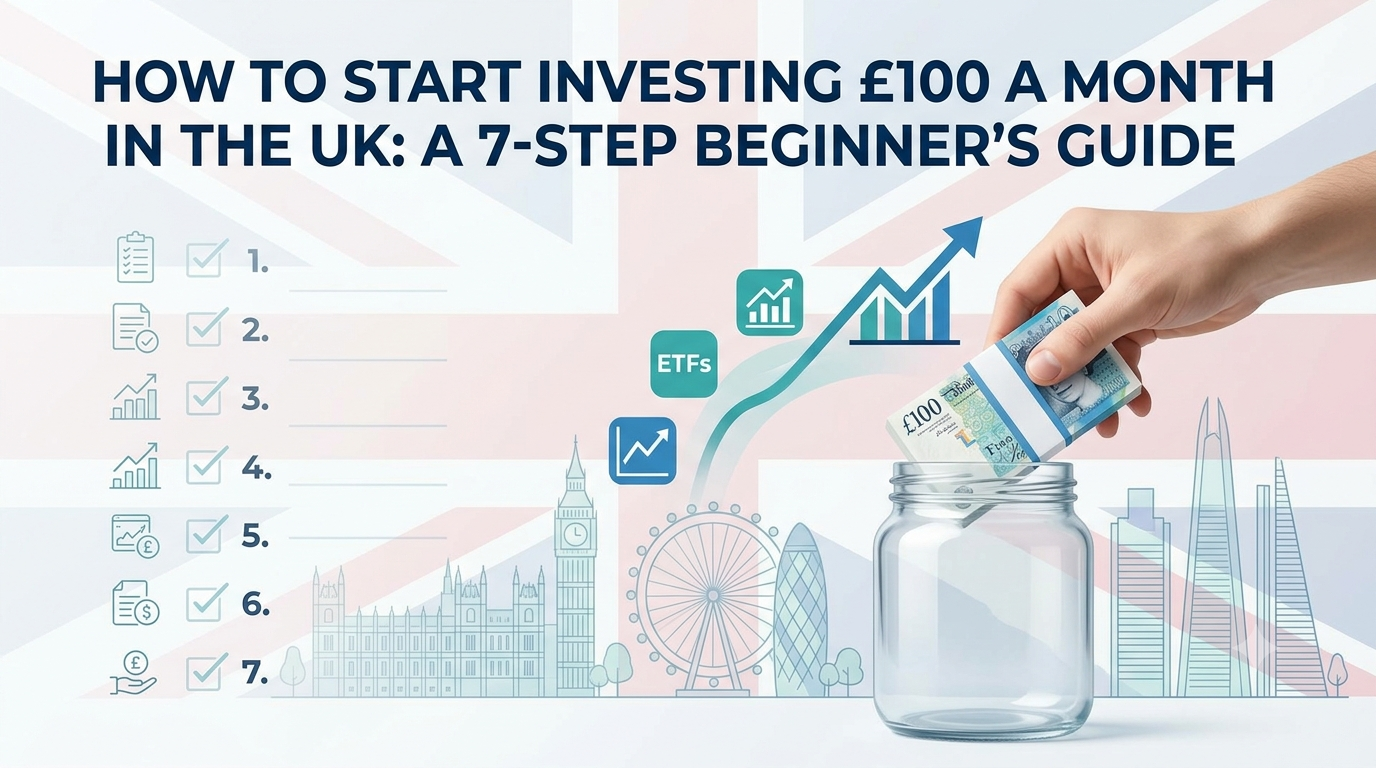
How to Start Investing £100 a Month in the UK: A 7-Step Beginner’s Guide
£100 a month may not feel like enough to start investing. It is easy to assume you should wait until you earn more, understand every market term or have a large lump sum ready.
But £100 a month is £1,200 invested each year. More importantly, it can help you build a repeatable habit while your knowledge, income and contributions grow.
This guide explains how to start investing £100 a month in the UK using a straightforward seven-step plan. You will learn what to sort out first, which account to consider, how to choose a diversified investment and what your money could become over time.
The short answer
If your essential finances are stable and you will not need the money for at least five years, one practical approach is to invest £100 automatically each month into a diversified, low-cost fund or ETF held inside a Stocks and Shares ISA.
This is an educational example, not a recommendation for your circumstances. Investments can fall as well as rise, and you may get back less than you invest.
Can you really start investing with £100 a month?
Yes. Some UK investment platforms accept regular contributions of £100 or less. The practical question is not whether £100 is a respectable amount. It is whether investing is suitable for your goal, time frame and wider financial position.
The FCA’s Financial Lives 2024 research found that 90% of UK adults had cash savings, but only 35% had investments. Investing is not reserved for high earners, but it does require a willingness to accept uncertainty and leave the money invested for the long term.
A small, affordable contribution that continues through good and bad markets may be more useful than an ambitious amount you stop after three months. Starting with £100 also lets you learn how an investment account behaves before committing larger sums.
Before investing £100 a month, check your foundation
Investing should not leave you unable to pay bills or deal with an emergency. Before setting up the monthly payment, work through these three checks.
1. Keep priority bills under control
Mortgage or rent, council tax, energy and other priority commitments come before investing. If you are missing essential payments or borrowing to cover food and bills, focus on stabilising your cash flow first.
2. Build accessible emergency savings
MoneyHelper suggests aiming for three to six months of essential outgoings in an instant-access savings account. That target can take time, so begin with a smaller starter buffer if necessary.
If a broken boiler would otherwise force you to sell investments or use a credit card, your emergency fund needs attention. Investment prices may be down at the exact moment you need the money.
3. Deal with expensive debt
A credit card charging 24.9% creates a guaranteed cost. Investment returns are uncertain. MoneyHelper’s general guidance is to deal with expensive debt and build an emergency fund before investing money you will not need for the next few years.
You do not necessarily need to clear a low-rate mortgage or every student loan first. However, high-interest credit cards, overdrafts and short-term loans can work against your wealth much faster than a portfolio is likely to grow.
Also check your workplace pension. Employer contributions are part of your overall remuneration, so understand what you could lose before reducing or opting out of pension contributions to fund an ISA.
For a broader sequence covering emergency savings, debt and investing, read Building Wealth with ISAs and ETFs: A Practical 6-Step UK Plan.
How to start investing £100 a month in the UK
Step 1: Give the £100 a long-term job
Decide what you are investing for. A goal gives you a time frame and helps you judge how much risk is reasonable.
- Money for a holiday next year usually belongs in cash.
- A house deposit needed in three years should not depend on stock-market performance.
- Money intended for financial independence or retirement in 15–30 years may have time to recover from market falls.
The FCA says investing over a time frame of at least five years can give investments more opportunity to ride out short-term performance dips. Five years is not a guarantee that you will make money, but it is a useful minimum starting point when considering stock-market investments.
Write down one sentence: “I am investing £100 a month for ______, and I do not expect to need it until ______.” If you cannot complete that sentence, clarify the goal before choosing an investment.
Step 2: Choose the right account
For many UK beginners investing for a flexible long-term goal, a Stocks and Shares ISA is worth considering. The ISA is a tax wrapper rather than an investment: you still need to choose what to hold inside it.
For the 2026/27 tax year, the overall adult ISA allowance is £20,000. Eligible interest, dividends and capital gains generated inside an ISA are generally sheltered from UK tax. Investing £100 a month would use £1,200 of that annual allowance.
Read the current UK ISA rules and allowances for 2026/27 and the complete GOV.UK ISA guidance before contributing.
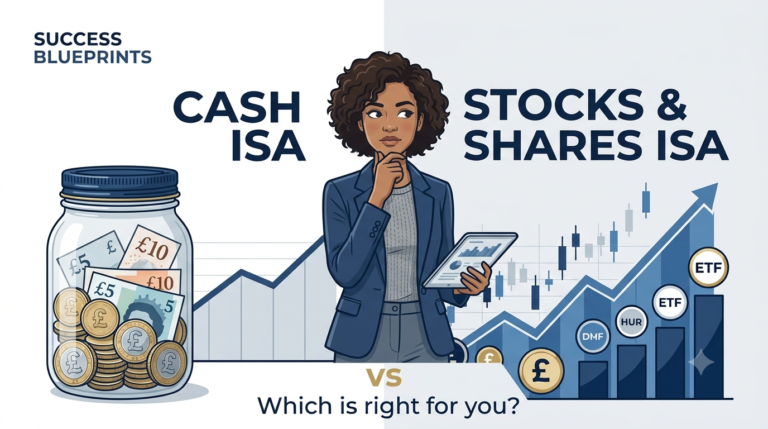
A Cash ISA is usually better suited to emergency savings and shorter-term goals because the balance does not move with the stock market. Our Cash ISA vs Stocks and Shares ISA guide explains the differences in risk, access, inflation and time frame.
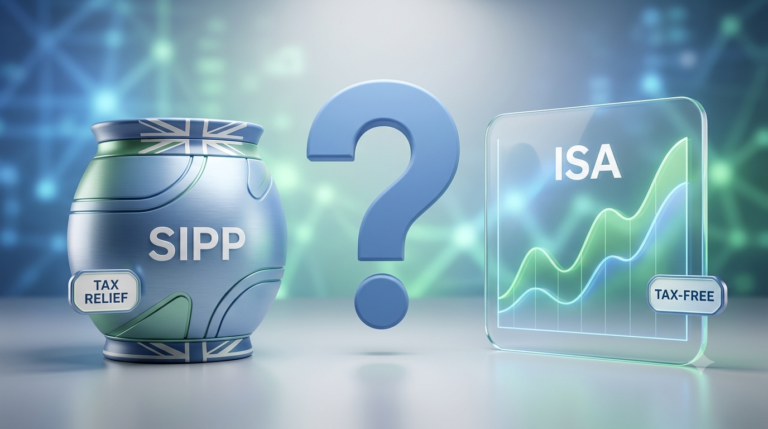
If the goal is retirement, compare an ISA with your workplace pension or a personal pension. Pensions can provide tax advantages and employer contributions, but access is restricted until the relevant pension age. An ISA is generally more flexible, although it does not include employer contributions.
Step 3: Compare FCA-authorised platforms
The investment platform administers your ISA, holds your investments and processes purchases and withdrawals. Do not choose solely because an app looks simple or an influencer mentions it.
Use the FCA Firm Checker to confirm that the provider is authorised and has permission to provide the service. Then compare:
- Account or platform fees
- Fund and ETF charges
- Dealing fees for each monthly purchase
- Foreign-exchange charges
- Minimum regular investment amounts
- Whether fractional ETF investing is available
- Automatic investing and direct-debit features
- ISA transfer and exit charges
- Customer service and account security
A £5 dealing fee would immediately consume 5% of a £100 contribution. A platform offering low-cost regular purchases may therefore be more suitable for small monthly amounts than one designed for occasional large trades.
Eligible investment claims may receive up to £85,000 of FSCS protection per person, per firm if an authorised investment firm fails and cannot meet a valid claim. Check the FSCS investment rules carefully. FSCS does not compensate you simply because an investment falls in value.
Step 4: Choose one understandable, diversified investment
Opening the ISA is only the beginning. Money transferred into the account may remain as cash until you select an investment.
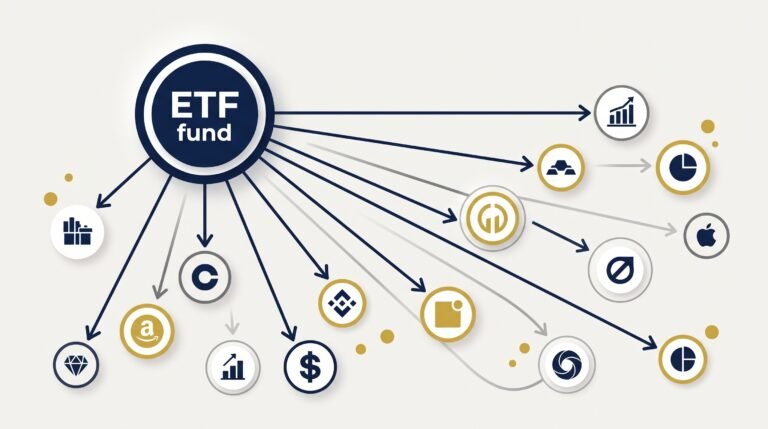
Many beginners research a broad global index fund or ETF. One such fund may hold shares in hundreds or thousands of companies across different countries and industries. This reduces your dependence on the fortunes of one company, although a global fund can still fall sharply when markets decline.
An investor who is uncomfortable with an all-share portfolio might research a diversified multi-asset fund combining shares and bonds. It may fluctuate less than a 100% equity portfolio, but bonds also carry risk and a more cautious mix may have lower long-term growth potential.
The FCA explains that diversification across investments such as international shares and bonds can reduce risk because poor performance in one area may be partly offset by another. Diversification reduces concentration risk; it does not eliminate the possibility of losing money.
Before buying a fund, read its fact sheet and check:
- Which index or strategy it follows
- Countries, sectors and largest holdings
- Equity and bond allocation
- Ongoing charge
- Accumulation or income share class
- Risk rating and past volatility
- Whether it overlaps with funds you already own
Avoid buying a collection of fashionable funds without understanding their holdings. Five funds can still be poorly diversified if they all own the same large technology companies.
Step 5: Understand every layer of fees
Fees reduce the money left to compound. A platform described as “commission-free” may still charge for currency conversion, fund management, subscriptions or the difference between an ETF’s buying and selling prices.
| Cost | What it pays for | Why it matters at £100 a month |
|---|---|---|
| Platform fee | Using the ISA provider | A fixed monthly fee can be expensive on a small balance |
| Fund or ETF charge | Managing and operating the investment | Deducted continually and compounds over time |
| Dealing fee | Buying or selling | Frequent small purchases can lose a large percentage immediately |
| Foreign-exchange fee | Converting currencies | Can apply to overseas investments or trades |
| Bid-offer spread | Difference between buy and sell prices | An indirect trading cost, especially for less-liquid ETFs |
The lowest-cost option is not automatically the best. Investment choice, service, security and ease of use also matter. The aim is to understand the total cost and avoid paying for features you do not need.
Step 6: Automate the contribution and purchase
Set the £100 contribution for shortly after payday, when the money is less likely to be absorbed by other spending. Where the platform allows it, automate both the transfer and the purchase of your selected fund.
The FCA notes that investing monthly over five or more years can smooth the effect of short-term market movements. A fixed contribution buys more units when prices are lower and fewer when they are higher.
This is sometimes called pound-cost averaging. It does not guarantee a profit or prevent losses. Its main value is behavioural: it reduces the temptation to delay every purchase while waiting for the “perfect” time.
A simple payday system
- Salary arrives.
- Essential bills and agreed debt payments are covered.
- £100 moves automatically to the Stocks and Shares ISA.
- The platform automatically purchases the selected diversified fund.
- You record the contribution and continue with your month.
Step 7: Review annually rather than reacting daily
Checking the account every day can turn a long-term plan into an emotional experience. Prices will rise and fall. Headlines will repeatedly claim that this is the best or worst time to invest.
Schedule a review once or twice a year. Check whether:
- Your goal and time frame have changed
- Your emergency fund is still adequate
- The investment still follows the strategy you selected
- Fees or platform terms have changed
- Your portfolio has drifted away from its intended allocation
- You can increase the monthly contribution after a pay rise or cleared debt
Increasing £100 to £110 may feel insignificant, but gradual increases can make a large difference over decades. Consider raising the payment by part of every future pay rise rather than relying on one dramatic change.
What could investing £100 a month become?
The following illustration assumes £100 is invested at the end of each month and earns an average return of 5% a year after costs, compounded monthly.
| Time invested | Your contributions | Illustrative value at 5% | Illustrative growth |
|---|---|---|---|
| 5 years | £6,000 | £6,801 | £801 |
| 10 years | £12,000 | £15,528 | £3,528 |
| 20 years | £24,000 | £41,103 | £17,103 |
| 30 years | £36,000 | £83,226 | £47,226 |
These figures are not forecasts. Real returns will be uneven, fees may be higher or lower, and the final value could be substantially different. Inflation will also reduce what the future amount can buy.
The table illustrates why time matters. During the first five years, most of the balance comes from your contributions. Over longer periods, growth on earlier growth can become a larger part of the total. This is compounding.
Should you choose an ETF or an index fund?
An ETF is a type of fund traded on a stock exchange throughout the day. An index fund follows an index, but it may be structured as an ETF or as a traditional fund priced once each day.
For somebody investing £100 a month, the label matters less than the practical details:
- Does it provide the diversification you want?
- Can your platform automate the purchase?
- Can you invest the full £100, or must you buy whole ETF shares?
- Are there dealing fees or bid-offer spreads?
- What is the ongoing charge?
A traditional index fund may allow exact pound-based regular investing without trading fees on some platforms. An ETF may offer lower ongoing charges or a wider choice, but dealing arrangements vary. Compare the complete cost on your chosen platform.
Common £100-a-month investing mistakes
Investing money needed soon
A market fall can happen shortly before your deadline. Keep emergency money and fixed-date short-term goals in an account suited to capital stability and access.
Confusing investing with trading
Frequent trading, leveraged products and contracts for difference are very different from making long-term contributions to a diversified fund. Do not enter a CFD account when you intended to open an Invest or ISA account.
Chasing last year’s winner
Past performance does not reliably identify the next winning market or fund. Buying after dramatic price rises can expose you to concentrated risk driven by hype.
Owning too many overlapping funds
More funds do not automatically mean more diversification. Check the underlying holdings before adding another investment.
Ignoring fixed fees
A modest fixed fee can represent a high percentage of a small portfolio. Recalculate the total cost as your balance and contribution change.
Stopping because markets fall
Market declines are uncomfortable, but they are part of investing. If a normal fall would cause you to sell immediately, review whether the portfolio contains more risk than you can tolerate.
Frequently asked questions
Is £100 a month enough to invest?
Yes, if the platform accepts that amount and the fees are reasonable. £100 a month builds an investing habit and totals £1,200 each year. The contribution should be affordable and used for a long-term goal rather than bills, emergency costs or expensive debt repayments.
Should I clear debt before investing £100 a month?
Usually prioritise mortgage or rent arrears, council tax, essential bills and expensive consumer debt. Consider maintaining enough workplace pension contributions to receive valuable employer contributions. The right balance depends on debt costs, penalties, emergency savings and your wider circumstances.
What is the best investment for £100 a month?
There is no universally best investment. Many beginners research a diversified global index fund or a multi-asset fund because one investment can spread money across many holdings. Your goal, time frame, risk tolerance, costs and existing investments should guide the decision.
Is a Stocks and Shares ISA better than a pension?
They serve different purposes. An ISA usually offers flexible access and tax-sheltered eligible returns. A pension may provide tax relief and employer contributions but restricts access until the permitted pension age. Many people use both for different goals.
What should I do when my investment falls?
Check whether your goal, time frame or chosen investment has fundamentally changed. A normal market fall is not automatically a reason to sell. If losses cause serious anxiety or threaten a near-term goal, reassess whether you are taking more risk than you can afford.
Your £100-a-month action plan
- Stabilise bills, emergency savings and expensive debt.
- Choose a goal at least five years away.
- Compare a Stocks and Shares ISA with any relevant pension options.
- Check potential providers with the FCA.
- Research one understandable, diversified investment.
- Calculate the total platform and investment costs.
- Automate £100 after payday and review the plan annually.
You do not need perfect market timing to begin. You need an affordable amount, a suitable account, a diversified plan and enough patience to continue when investing feels less exciting.
Get your free UK investing starter kit
Download the free Success Blueprints UK ETF & ISA Starter Kit for practical checklists covering ISA setup, beginner ETF research, fees and your first £100 investment.
You can also join the Success Blueprints newsletter for one practical UK money strategy each week.
Important: This article is for education and information only and does not constitute personalised financial advice. Tax and ISA rules can change. Investments can fall as well as rise, and you may get back less than you invest. Consider regulated financial advice if you are unsure what is suitable for you.
One Comment
Comments are closed.